
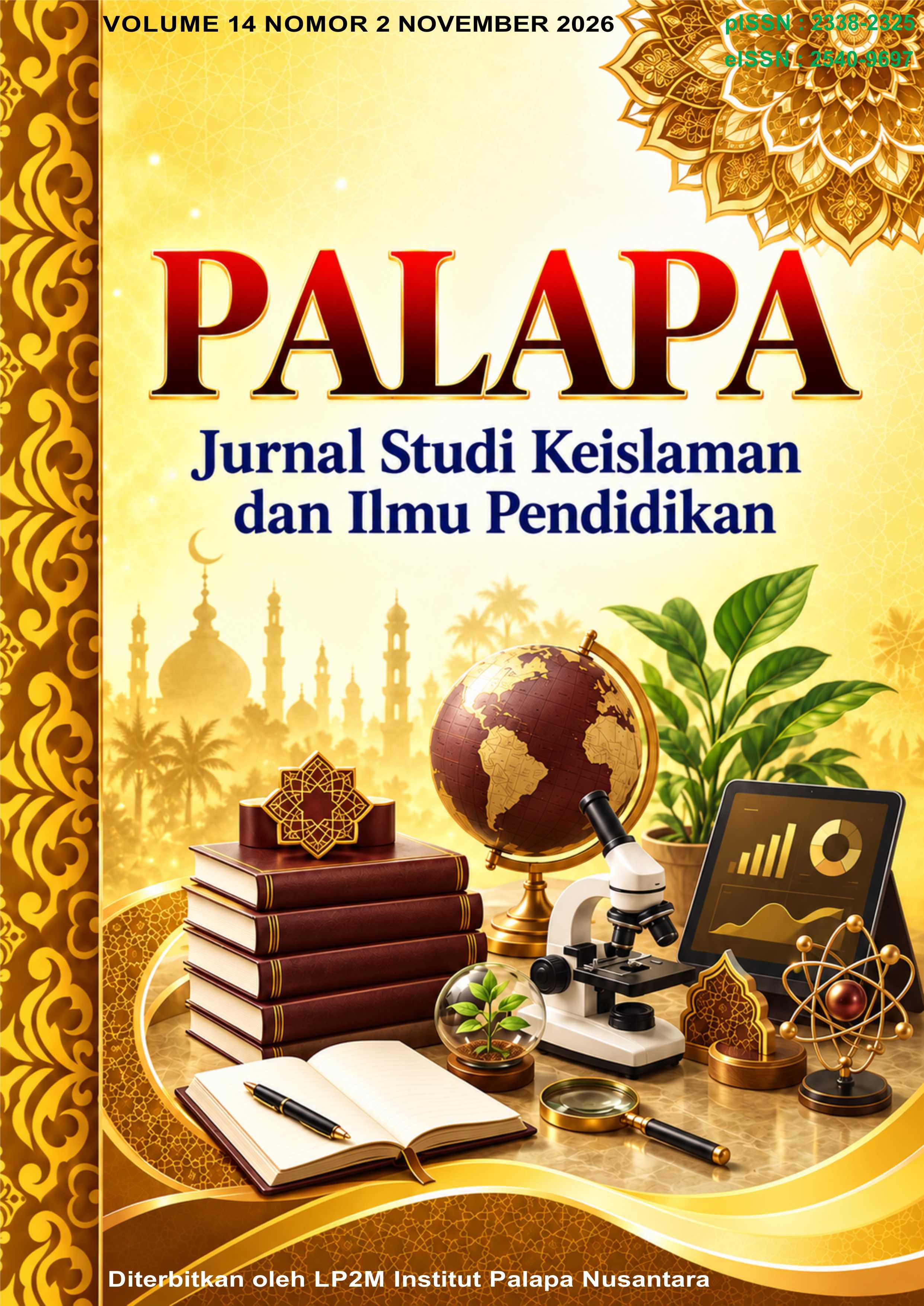
Cultivating Empathic Compassion in Aqidah Akhlak Learning as a Bullying Prevention Strategy at Madrasah Aliyah Tarbiyatul Mustafid Narmada

Article Sidebar
 Digital Object Identifier:
10.36088/palapa.v14i2.6300
 Viewed : 24 times
 Downloaded : 20 times














Main Article Content
1 UIN Mataram, Indonesia, 2 UIN Mataram, Indonesia, 3 UIN Mataram, Indonesia
Abstract
This study is motivated by the limited research that explicitly positions empathic compassion as the core of bullying prevention in Aqidah Akhlak learning, despite the persistence of verbal bullying and social exclusion in madrasah settings. This study aims to analyze the strategies used by the Aqidah Akhlak teacher to cultivate empathic compassion as a bullying prevention strategy and to identify the obstacles and solutions encountered in this process at Madrasah Aliyah Tarbiyatul Mustafid Narmada. A qualitative descriptive phenomenological design was employed, involving one Aqidah Akhlak teacher, one guidance and counseling teacher, and one perpetrator–victim pair from class XI.1 as key cases selected through purposive sampling. Data were collected through classroom observations, semi-structured interviews, and documentation, and were analyzed using Miles and Huberman’s interactive model, supported by triangulation of sources, techniques, and time to ensure credibility. The findings reveal three mutually reinforcing strategies: communicative value-based lectures, case-based reflective group discussions, and role play with guided reflection. These strategies activated perspective-taking in the perpetrator, consistent with Martin L. Hoffman’s moral empathy theory. The study concludes that cultivating empathic compassion plays a critical role in shifting how students interpret and respond to bullying. However, its effectiveness remains constrained by time limitations, peer group pressure, and limited parental involvement, indicating the need for broader ecosystem-based interventions. This study contributes to the literature on Islamic moral education and bullying prevention by demonstrating the role of empathic compassion in strengthening students’ moral awareness and prosocial responses, while also opening opportunities for future multisite and mixed-methods research.
Citation Metrics:


Downloads
Article Details

Authors retain copyright and grant the journal right of first publication with the work simultaneously licensed under a Creative Commons Attribution-NonCommercial-ShareAlike 4.0 International License that allows others to share the work with an acknowledgement of the work's authorship and initial publication in this journal.
Find the perfect home for your research! If this journal isn't the right fit, don't worry—we offer a wide range of journals covering diverse fields of study. Explore our other journals to discover the ideal platform for your work and maximize its impact. Browse now and take the next step in publishing your research:
| HOME | Yasin | AlSys | Anwarul | Masaliq | Arzusin | Tsaqofah | Ahkam | AlDyas | Mikailalsys | Edumalsys | Alsystech | AJSTEA | AJECEE | AJISD | IJHESS | IJEMT | IJECS | MJMS | MJAEI | AMJSAI | AJBMBR | AJSTM | AJCMPR | AJMSPHR | KIJST | KIJEIT | KIJAHRS |