
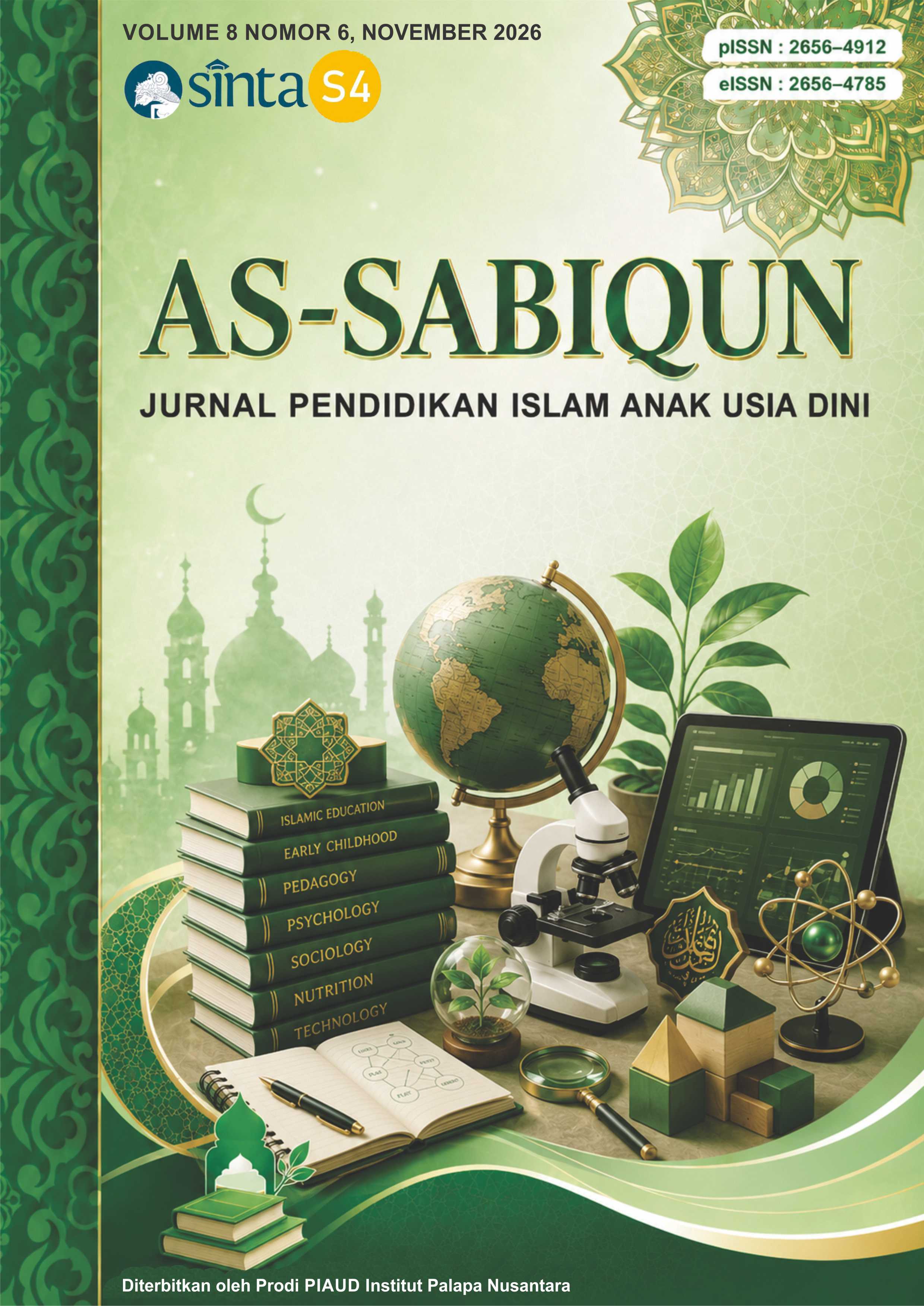
Efektivitas Permainan Number Path Maritim terhadap Number Sense Anak Usia 5–6 Tahun

Article Sidebar
 Digital Object Identifier:
10.36088/assabiqun.v8i6.6625
 Viewed : 28 times
 Downloaded : 17 times














Main Article Content
1 STAI DDI Pangkep, 2 STAI DDI Pangkep
Abstract
Maritime-themed linear number board games offer a learning context for developing young children’s number sense. This study aimed to evaluate, through simulation, the effectiveness of a maritime-themed linear number path game in strengthening number sense among children aged 5–6 years within the setting of TK Harapan Bangsa in Pangkep Regency. The study employed a quantitative approach based on a controlled synthetic dataset representing a quasi-experimental nonequivalent pretest–posttest control group design, with 20 children each in the experimental and comparison groups. The intervention scenario comprised 12 small-group sessions using a maritime-themed number path board numbered 1–20 and structured mathematical conversations (math talk), while the comparison scenario involved routine mathematics activities. The competencies analyzed included numeral identification, quantity–symbol mapping, numerical magnitude comparison, number ordering, and basic arithmetic. Data were analyzed using descriptive statistics, assumption tests, paired tests, gain comparisons, and analysis of covariance (ANCOVA), with pretest scores as a covariate. The simulation results showed an increase in the experimental group mean from 53.40 (SD = 5.90) to 72.75 (SD = 9.44), while the comparison group mean increased from 52.65 (SD = 5.21) to 62.70 (SD = 9.64). The between-group difference in mean gains of 9.30 points was statistically significant, t = 4.18, p < 0.001, with a large effect size (d = 1.32). ANCOVA showed a between-group difference after controlling for baseline scores, F(1, 37) = 16.81, p < 0.001, ηₚ² = 0.31. The greatest improvements occurred in numeral identification and quantity–symbol mapping, while basic arithmetic remained the most difficult domain. The simulation results provide an analytical illustration of patterns of improvement in number sense within a scenario involving repeated play of number games combined with structured mathematical conversations. The intervention’s effectiveness still requires empirical testing using verified field data and a sample from several schools.
Citation Metrics:


Downloads
Article Details

Authors retain copyright and grant the journal right of first publication with the work simultaneously licensed under a Creative Commons Attribution-NonCommercial-ShareAlike 4.0 International License that allows others to share the work with an acknowledgement of the work's authorship and initial publication in this journal.
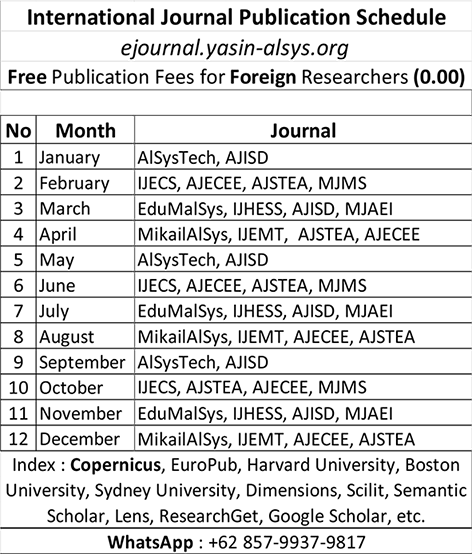
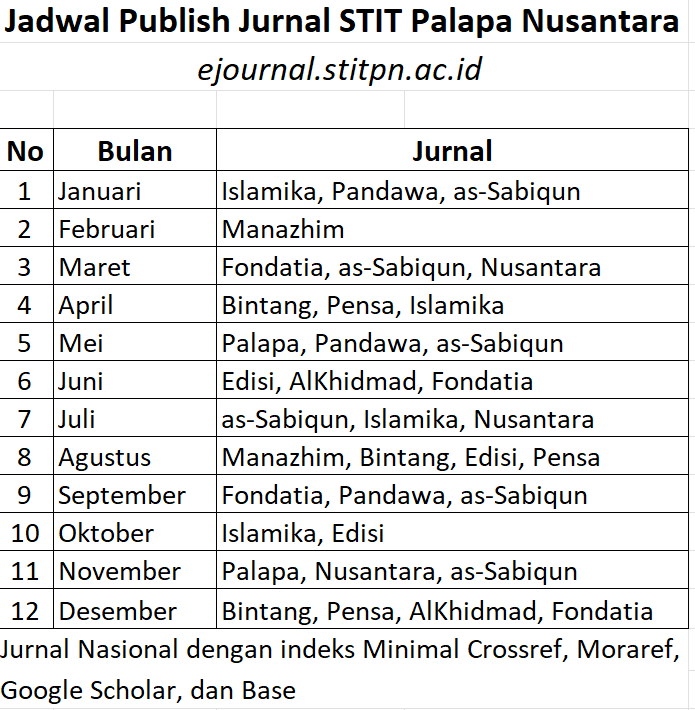
Find the perfect home for your research! If this journal isn't the right fit, don't worry—we offer a wide range of journals covering diverse fields of study. Explore our other journals to discover the ideal platform for your work and maximize its impact. Browse now and take the next step in publishing your research:
| HOME | Yasin | AlSys | Anwarul | Masaliq | Arzusin | Tsaqofah | Ahkam | AlDyas | Mikailalsys | Edumalsys | Alsystech | AJSTEA | AJECEE | AJISD | IJHESS | IJEMT | IJECS | MJMS | MJAEI | AMJSAI | AJBMBR | AJSTM | AJCMPR | AJMSPHR | KIJST | KIJEIT | KIJAHRS |